Fellowes LX85 vs Bonsaii C149-C in Canada: Which Shredder Fits?
Compare Fellowes LX85 and Bonsaii C149-C in Canada: run times, cooling breaks, safety controls and the limits of published cut-size claims.
10 min read
Work & Smart Living · Home office
Choose the Fellowes LX85 for recurring household paperwork when its SafeSense touch detection and shorter shredding sessions suit your routine. Choose the Bonsaii EverShred C149-C for a larger paper backlog when the longer rated run time matters most. Neither is an automatic-feed machine, and a longer duty cycle does not prove faster shredding.
Quick verdict: frequent small batches or a long clear-out?
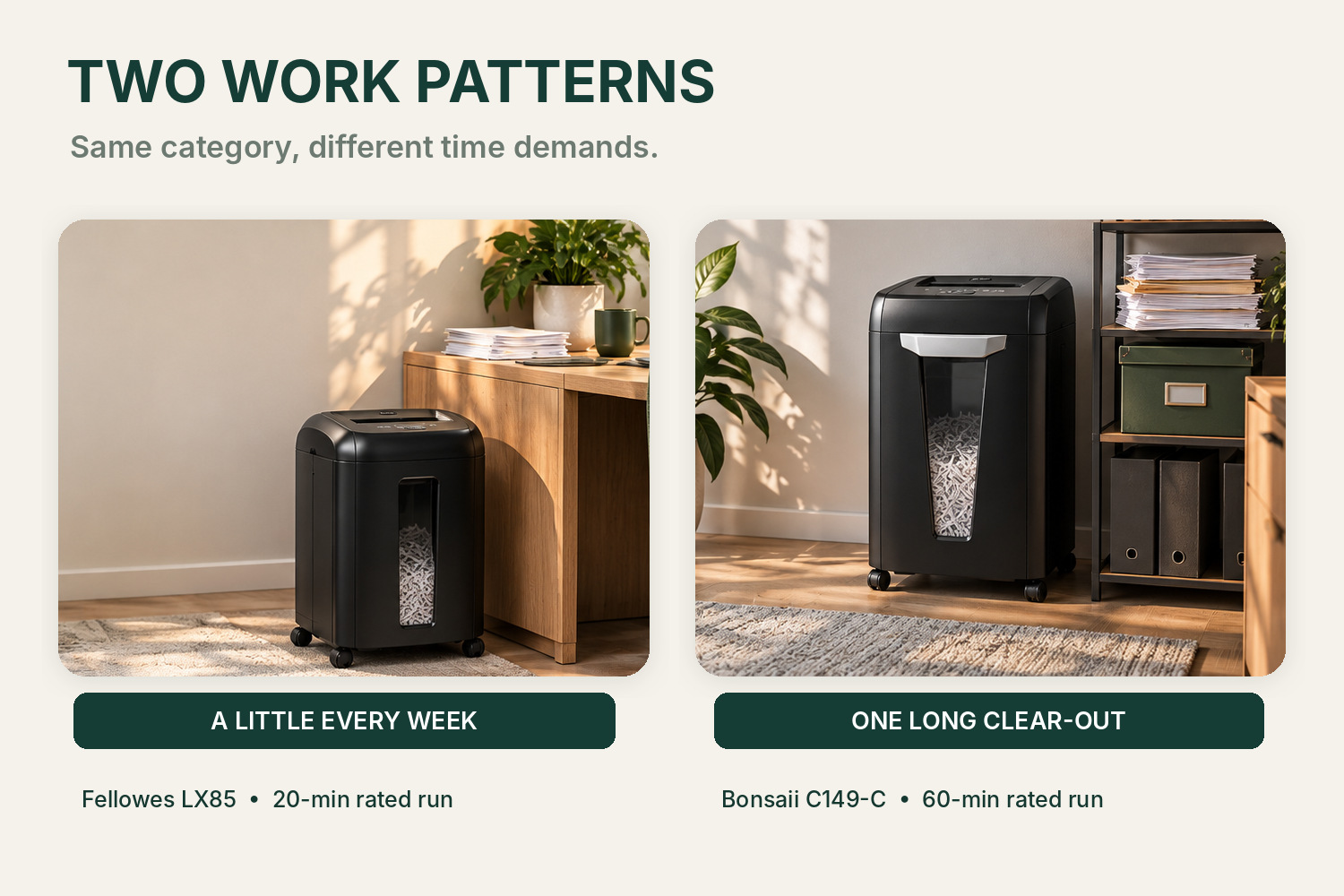
Hamejur favours the LX85 for a household that shreds a modest pile regularly and values an extra layer of touch detection at the entry. We favour the C149-C when you tend to save a large pile for one session. There is one evidence limitation: Bonsaii’s official page gives conflicting particle-length figures. We therefore do not claim that the two machines deliver identical cut security, even though both are marketed with a P-4 designation.
Editorial illustration, not a manufacturer photograph or hands-on test.
As an Amazon Associate, Hamejur earns from qualifying purchases. Amazon.ca prices and availability can change. Check the product page for current purchase details.
AI-generated category illustration; equipment shown is not a product photograph.
Products compared
Current picks at a glance
Price-neutral comparison based on verified product identity, official specifications, and buyer fit. Check Amazon.ca for current price and availability.
What matters most: your pile is not a laboratory stack
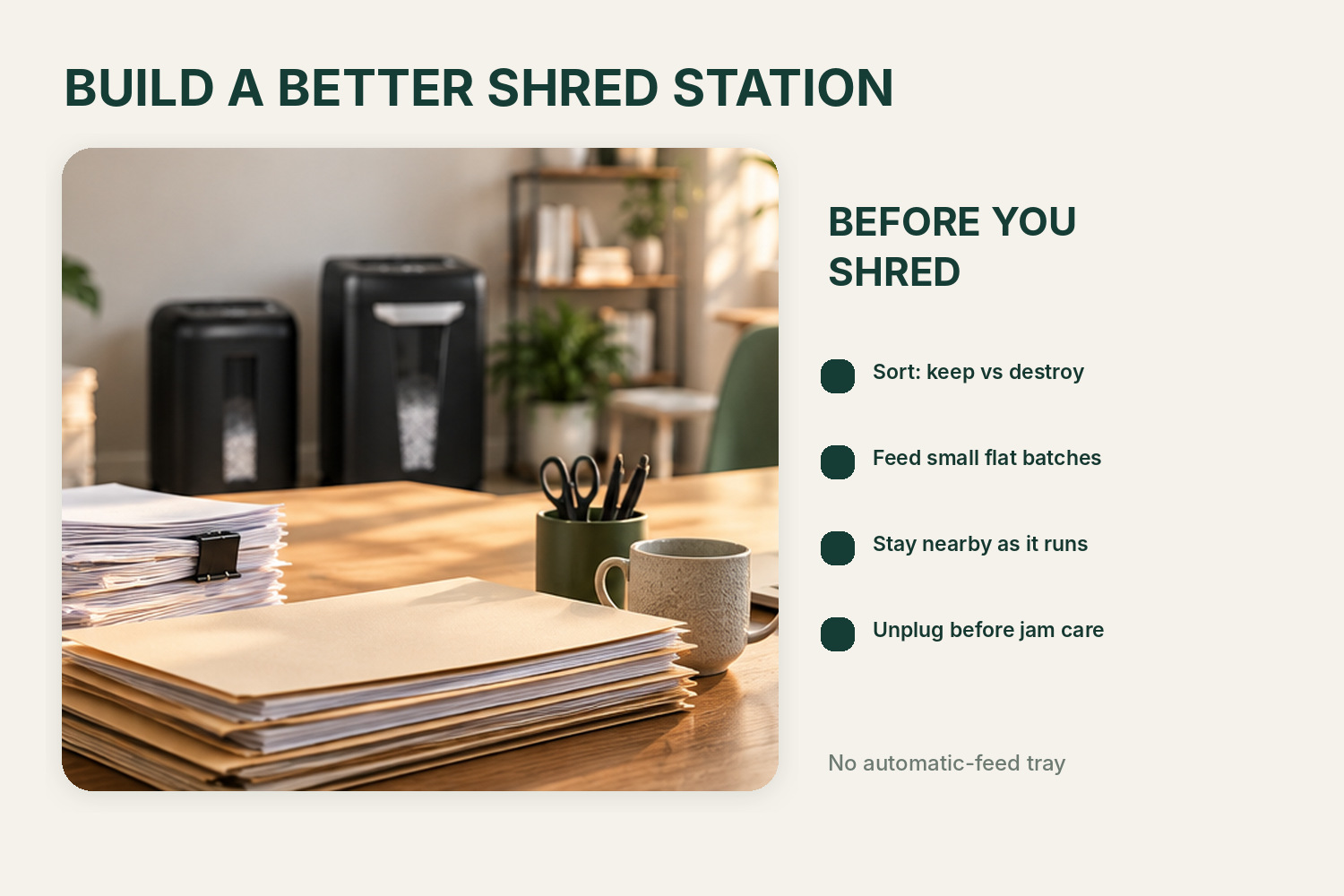
Start with the kind of material you actually need to destroy. A handful of plain sheets is a different load from folded correspondence, thick inserts and envelopes with attachments. Do not count a folded bundle as though every visible item were one ordinary sheet. Sort the pile before feeding, and stay within the instructions supplied with the exact unit.
Then decide whether your main frustration is waiting for a machine to cool, repeatedly emptying a bin, or remembering to use it at all. A higher sheet rating can be useful, but it will not fix a shredder stored somewhere inconvenient. A nearby machine used every week may be a better household system than a larger one saved for an annual backlog.
Security is a separate decision from convenience. A sheet count describes loading; a run-time rating describes a thermal operating limit. Neither establishes the size of the resulting fragments or whether a machine meets an organisation’s disposal requirements. If your workplace specifies a standard, obtain confirmation for the exact supplied model before buying.
Duty cycle, jam response and touch detection do different jobs
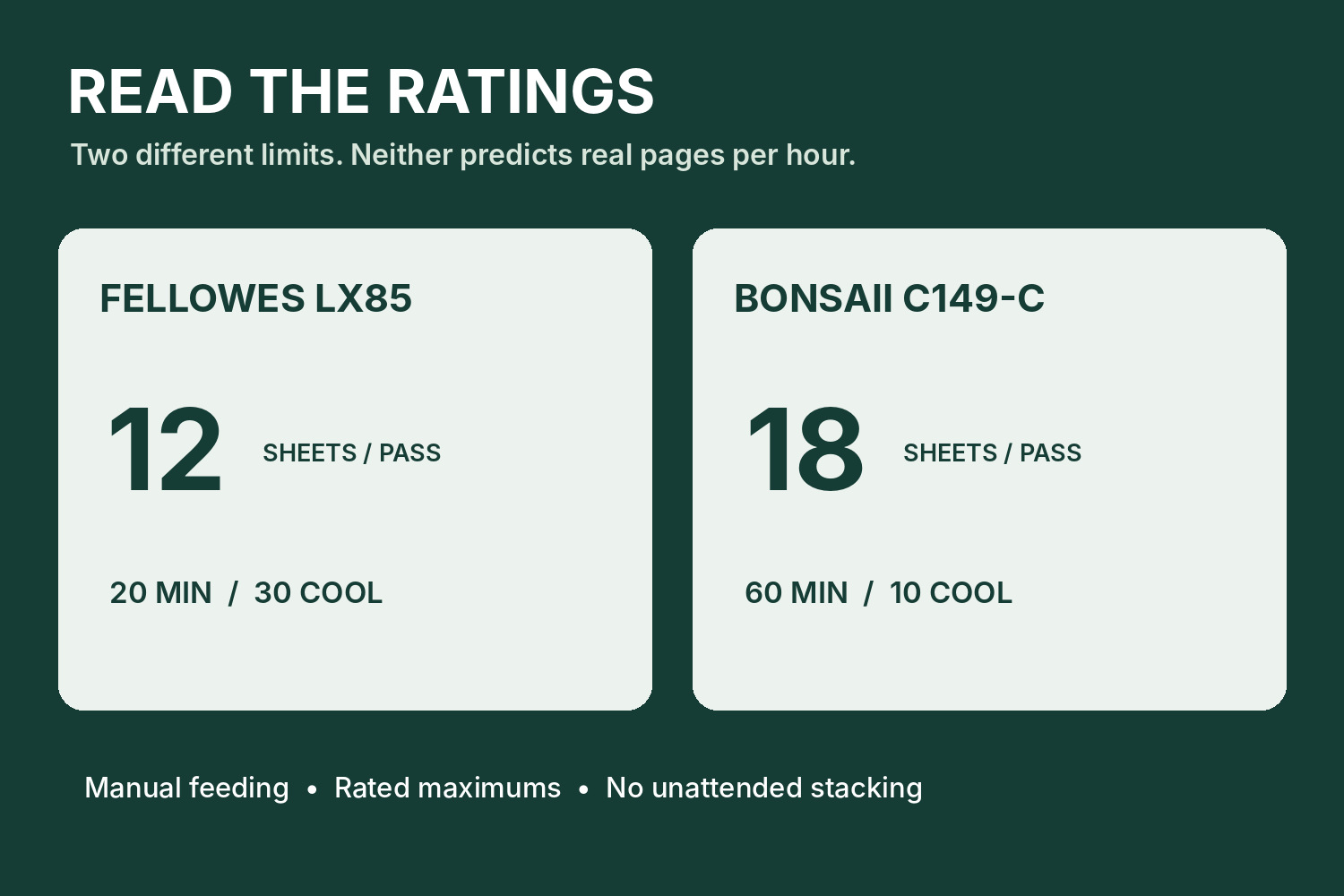
Hamejur’s interpretation: the C149-C’s rated uninterrupted running window is three times the LX85’s. That is a comparison of published time limits, not a claim that it processes three times as much paper. We have not measured feed speed, bin-emptying interruptions or actual pages per hour.
Consider a hypothetical job requiring 30 minutes of active shredding. On the stated limits, the LX85 would need a cooling break after the first 20 minutes; the C149-C’s stated running window could cover that active time. Sorting, feeding and emptying still add elapsed time to either job. This example helps interpret the limits without pretending to predict a real household’s completion time.
SafeSense responds to contact at the Fellowes entry area. Reverse is a response to feeding problems, while thermal protection addresses overheating. These functions solve different problems and should not be treated as interchangeable safety badges. No sensor makes it appropriate to leave children or pets with access to an operating shredder.
Detailed product evaluations
Fellowes LX85
The LX85 makes most sense when you want a manageable, regular disposal routine. Its touch detection and safety lock give you specific controls to understand and use. Read the manual before the first session, locate the reverse and off controls, and decide where the machine will be stored when it is not in use.
The shorter rated operating window is not automatically a drawback for a household clearing a week’s correspondence. If you rarely approach that limit, selecting a machine mainly for marathon operation solves a problem you do not have. The recommendation changes when long sessions are frequent: the cooling interval then becomes part of your working schedule.
Check model 4400401 on the Canadian listing. LX85 documentation exists for different electrical regions; a familiar product-family name does not establish the correct supply rating. Our comparison uses the family manual for operating guidance and avoids assigning its foreign voltage specification to this Canadian-market listing.
Best fit: frequent, smaller paper batches with an emphasis on accessible safety controls. Watch for: extended backlogs that will require a cooling pause. SafeSense supplements careful use; it does not replace unplugging the machine before tasks that require it.
Amazon.ca prices and availability can change. Check the product page for current purchase details.
Bonsaii EverShred C149-C
The C149-C is our workload-oriented choice. Its published running window and larger rated feed allowance can make a long session easier to plan. You still need to stand nearby and present batches to the entry. A stack on the desk is not an automatic-feed tray, so this is a poor choice if the capability you really want is unattended batch processing.
Allow room in front of the bin as well as beside the machine. A bin that slides out must have somewhere to go, and a clear path matters when you are handling loose fragments. Casters may help reposition it, but they do not make a cluttered corner a convenient emptying station.
Evidence limitation: Bonsaii’s page lists particle dimensions as 13/64 × 63/64 inch in one section and 13/64 × 1-37/64 inch in another. We cannot reconcile those lengths from that source. If a particular fragment size or security classification is essential, ask Bonsaii for documentation for the shipped unit. We do not resolve the conflict by copying the more favourable number.
Best fit: larger attended paper clear-outs. Watch for: buyers needing verified cut-size equivalence or an automatic-feed machine. Those requirements need a different evidence check or a different product.
Amazon.ca prices and availability can change. Check the product page for current purchase details.
Which fits your household?
A small weekly correspondence pile: the LX85 is the more natural fit if its safety controls matter to you and the session remains short.
A cupboard full of old paperwork: the C149-C is the stronger fit for longer attended operation. Sort first so the shredder is not running while you decide what to retain.
A small office with a written destruction policy: check the specified cut requirement, material types and model documentation before selecting either machine.
A household wanting to load a tray and leave: neither matches that workflow. Look for an explicitly documented automatic-feed architecture.
Setup: make safe handling easy
Confirm the model number, electrical rating and local seller/service terms. Do not substitute a foreign-voltage listing because the product photo looks familiar.
Place the machine on a suitable stable surface with space to open the bin. Keep the cord out of the walking path.
Read the approved-material list in the supplied manual. Do not infer that permission to shred a credit card also permits batteries, metal cards, padded envelopes or every kind of packaging.
Identify off, reverse and any lock controls before loading paper. Keep loose clothing, hair and hands away from the entry.
Start with a small, flat batch. Increase only within the stated sheet limit and stop if feeding becomes strained.
Editorial illustration, not a manufacturer photograph or hands-on test.
Maintenance and the cost of ignoring the bin
Fellowes’ LX85 manual calls for oiling when the bin is emptied and specifies suitable non-aerosol vegetable-based oil. Follow the model’s oiling sequence; do not improvise with household spray lubricants. For the C149-C, use Bonsaii’s instructions and approved maintenance supplies rather than assuming the Fellowes procedure transfers unchanged.
Check the bin before the next large batch. An easy-to-empty setup encourages you to stop at a sensible point instead of trying to force one last load through. When a jam needs attention, follow the maker’s reverse and shutdown procedure. Unplug before attempting any manual removal permitted by the instructions; never reach into a powered entry.
Budget time for sorting and disposal, not just shredding. Keep the “retain” pile physically separate from the “destroy” pile. Confirm that you no longer need an original before shredding it, especially when a scan is your only remaining copy. We have not estimated service life, repair frequency or annual maintenance costs for either model.
AI-generated category illustration; equipment shown is not a product photograph.
Avoid buying from a single large number
Do not read “18 sheets” as an instruction to feed every possible 18-item bundle. Do not read “60 minutes” as a promise of unattended operation or a measured productivity result. And do not let a security label override contradictory dimensions when your use depends on a defined cut specification. Resolve the requirement before the purchase, while the choice is still easy to change.
No such conclusion follows from the run-time ratings. They describe uninterrupted operating windows; actual throughput also depends on feeding, paper and interruptions.
Can I load a stack and leave either shredder?
These are manual-feed designs. Their continuous-run ratings do not turn them into unattended automatic-feed machines.
Does SafeSense remove the need for supervision?
No. Understand the detection feature and safety lock, follow the manual, and keep children and pets away from the operating machine.
Do both machines produce equivalent fragments?
We cannot establish that from the reviewed documentation. Bonsaii’s own page gives two particle lengths, so this article makes no equivalent-cut or certification claim.
Can I shred an original after scanning it?
Only after confirming you no longer need the original and that the saved copy is usable. The decision to retain a document comes before the choice of shredder.
Hamejur’s choice
We would choose the Fellowes LX85 for regular household disposal where its controls and shorter sessions match the task. We would choose the Bonsaii C149-C for longer attended clear-outs, provided exact cut-size certification is not an unresolved purchase requirement. If your priority is unattended feeding or a mandated destruction standard, settle that requirement before choosing either.
Check current listings
Compare the current Amazon.ca product pages
Use the product pages to confirm the exact variant, current price and availability before ordering.
Researched September 15, 2026. Amazon.ca identity checks matched Fellowes LX85 model 4400401 to ASIN B08SWHL5BZ and Bonsaii EverShred C149-C to ASIN B00IOFD08C. Technical evidence comes from the manufacturer pages and LX85 manual linked above. The manual covers multiple electrical regions; no foreign voltage or region-specific daily-volume figure is presented as a Canadian specification. Bonsaii’s conflicting particle dimensions are disclosed rather than treated as resolved. Workload scenarios are Hamejur’s interpretation of rated limits, not hands-on testing, measured throughput or compliance certification. No prices, stock claims or marketplace review summaries inform this article. Images are generic category illustrations.