Franklin ProSensor M210 vs Bosch GMS 120 in Canada: Which Wall Scanner Fits?
Franklin’s M210 prioritizes fast full-width stud mapping; Bosch’s GMS 120 adds dedicated wood, metal and live-wire modes.
6 min read
Products compared
Current picks at a glance
Price-neutral comparison based on verified product identity, official specifications, and buyer fit. Check Amazon.ca for current price and availability.
Amazon.ca prices and availability can change. Hamejur does not publish cached marketplace prices in no-API mode.
DIY & Home Tools
Short answer: choose the Franklin ProSensor M210 when your main job is finding the full width of wood or metal studs quickly. Choose the Bosch GMS 120 when you want a more investigative wall scanner with separate modes for wood, metal and energized wiring.
Quick Verdict: Which should you buy?
For shelves, cabinets and televisions on ordinary finished walls, the M210’s wide sensor array is the simpler workflow. Bosch’s GMS 120 asks you to select material mode, but provides deeper stated metal detection and a dedicated AC-wiring mode. Neither makes drilling automatically safe.
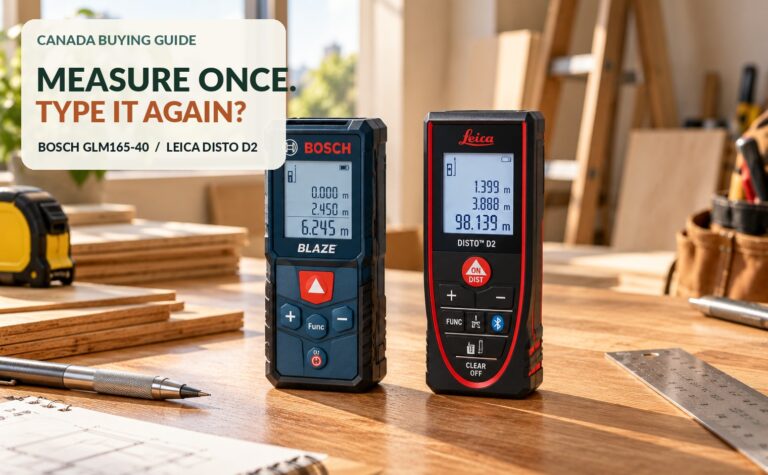
Match the scanner method to the material you need to locate.
Live-wire mode up to 2 in under suitable conditions
Illustrative comparison of the two scanning approaches; device appearance may differ from the exact products.
What matters most in this category
A single scan-depth number is not enough. Wood, steel, copper and energized conductors interact differently with sensing systems. The useful question is whether the sensing method matches the job. The M210 emphasizes spatial confidence: its array illuminates apparent stud width. GMS 120 emphasizes material discrimination: choose wood, metal or live wiring and interpret the centre indication.
Technology and architecture differences
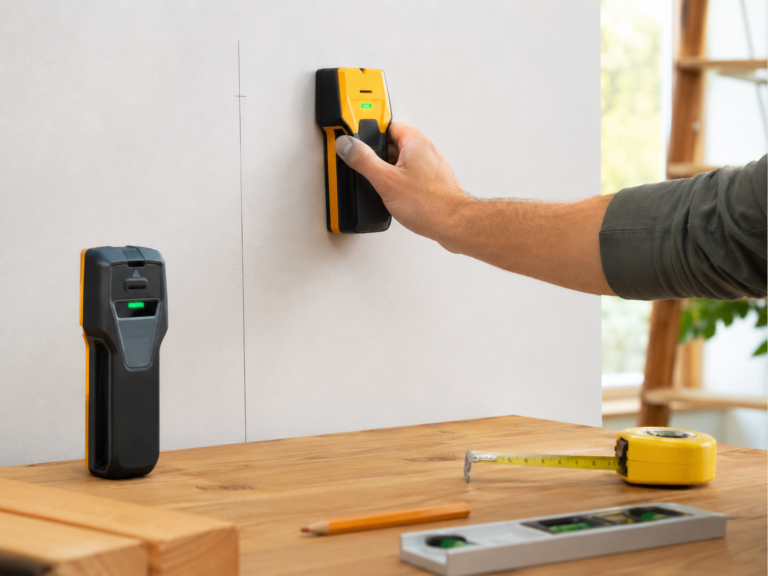
Illustrative workflow scene, not a demonstration of exact controls or a hands-on product test.
Franklin M210: wide-array mapping
Franklin specifies 13 sensors and 21 LEDs. Instead of calibrating over an assumed empty area and hunting for one edge, the array displays multiple points across the target. This is useful when framing is doubled or irregular.
The buyer implication is speed. Seeing both edges reduces the need to infer centre from separate passes. Its bubble level and pencil caddy fit a mounting-oriented workflow.
Best fit: routine wall mounting. Watch for: live-wire indication is a warning aid, not proof an area is electrically safe.
Amazon.ca prices and availability can change. Check the product page for current purchase details.
Bosch GMS 120: selectable multi-material scanning
Bosch provides wood, metal and AC wiring modes, an illuminated status ring and automatic centre finding. Its manual separates maximum depth by target: up to 4-3/4 inches for ferrous metal, 3-1/8 inches for non-ferrous metal such as copper, 2 inches for energized wiring, and 1-1/2 inches for wood substructures.
Those numbers are not one common test. They reveal what Bosch designed the scanner to investigate. If you are tracing metal deeper in a wall or distinguishing framing from metal, selectable modes are more informative.
Best fit: mixed-material renovation. Watch for: depth depends on target and wall structure.
Amazon.ca prices and availability can change. Check the product page for current purchase details.
Scenario-based decision guide
TV or shelf on drywall: M210’s full-width display is direct.
Older wall with uncertain metal: GMS 120’s metal mode gives more information.
Possible wiring: both offer warnings, but neither replaces circuit isolation and a suitable tester.
Many fastening points: Franklin’s no-calibration workflow reduces steps.
Need to identify target type: Bosch’s modes better match that question.
Illustrative renovation scenario; scanner warnings do not establish that a wall is safe to drill.
Compatibility, setup and technique
Keep the scanner flat, move at the recommended pace and repeat suspicious readings from both directions. Tile, foil-backed insulation, lath, dense plaster, moisture and closely spaced services can complicate detection. Compare readings with visible clues such as receptacle locations and likely framing direction.
Ownership and maintenance
Both are low-maintenance and need no app for their basic workflow. Battery condition matters. Keep fresh cells available and remove batteries before long storage.
Buying advice and avoidable mistakes
Do not buy solely from the deepest number. Bosch’s deepest specification applies to certain metal targets, not wood studs. Franklin’s wide display is not an X-ray image. Both infer hidden material from signals affected by the wall assembly.
Franklin states no calibration step is required; press and hold the button and scan.
Can Bosch GMS 120 detect pipes?
It can detect metal objects including steel and copper, subject to material, size, depth and wall conditions.
Can either guarantee there is no live wire?
No. Electrical detection is conditional. Use proper electrical-safe procedures before drilling.
Which is easier for a first shelf installation?
M210’s wide LED mapping is simpler when the goal is locating a stud centre.
Which is better for older homes?
GMS 120 can be more informative for separate wood and metal investigation, while M210 can reveal irregular or doubled framing. Wall construction can complicate both.
Hamejur conclusion: what I would choose
The practical split is wide stud mapping versus multi-material investigation. For repeated mounting on conventional finished walls, M210 is efficient. For renovation where metal and wiring are part of the question, GMS 120’s selectable modes justify extra interpretation.
Check current listings
Compare the current Amazon.ca product pages
Use the product pages to confirm the exact variant, current price and availability before ordering.
Technical specifications were checked against Franklin Sensors official M210 documentation and Bosch official GMS 120 documentation. Amazon.ca identities were checked separately through public-web marketplace evidence on October 2, 2026. Hamejur did not perform hands-on testing. Amazon.ca prices and availability can change; check the product page for current purchase details.
Prices change often, check Amazon for the current price.
Frequently Asked Questions
Which stud finder is better for a beginner hanging shelves or a TV?
The Franklin M210. Its 13-sensor array and 21-LED display show the stud's full width, edges and centre, with no calibration step: press, hold and scan. That is the simpler workflow for ordinary finished drywall.
Do I need the Bosch's live-wire mode, or is the Franklin's warning enough?
Neither tool can prove a drilling spot is electrically safe. The Bosch adds a dedicated AC-wiring mode rated to 2 inches under suitable conditions, while the Franklin's Live Wire Meter is a warning aid. In both cases, treat detection as conditional and follow electrical-safe procedures before drilling.
Which scanner is more accurate for finding studs?
They answer the question differently. The Franklin maps width across its array, which also reveals doubled or irregular framing. The Bosch asks you to select a material mode, then indicates the object's centre. The article frames it as spatial confidence versus material discrimination, not a single accuracy winner.
Which handles plaster or thicker walls better?
The article does not crown one. Tile, foil-backed insulation, lath, dense plaster, moisture and closely spaced services can complicate detection for both scanners. Keep the scanner flat, scan slowly, repeat from both directions, and cross-check against clues like outlet locations.
Is the Bosch GMS 120 worth more for occasional DIY?
Only if your jobs go beyond studs. For routine mounting, the Franklin's no-calibration workflow is enough. The Bosch justifies itself in renovation work where wood, metal and energized wiring all need separate investigation.
Can the Bosch GMS 120 detect pipes before drilling in a kitchen or bathroom?
It can detect metal objects including steel and copper pipes, subject to material, size, depth and wall conditions. Its stated maximums are 4-3/4 inches for ferrous metal and 3-1/8 inches for non-ferrous metal such as copper.
Franklin Sensors M90 vs ProSensor 710 in Canada compared by sensor count, depth wording, LED display, batteries, safety limits and simple home-project…