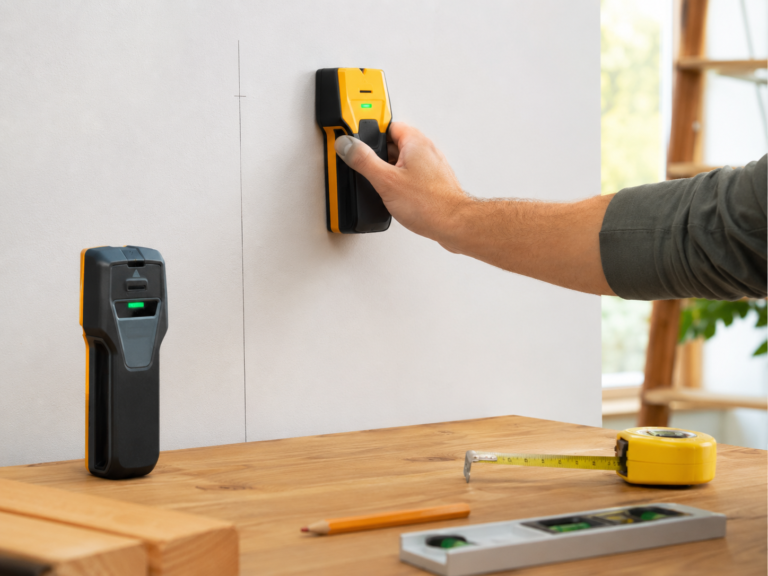
Franklin Sensors M90 vs ProSensor 710 in Canada is a practical comparison for renters and homeowners who want a simple stud finder for shelves, curtain rods, wall anchors, TV brackets, cabinet rails, and basic home projects. The M90 is the more compact choice with 9 sensors and a 1.5-inch deep-scan style listing. The ProSensor 710 is the wider classic model with 13 sensors and up to 1.6-inch deep-scan wording on the Amazon.ca listing path.
Both models are designed around Franklin’s no-calibration, full-width stud display approach. The important decision is whether you want the smaller M90 for simple household jobs or the wider 710 for more LED coverage across the stud width.
Franklin Sensors M90 vs ProSensor 710 in Canada: quick answer
Choose Franklin Sensors M90 if you want the smaller, newer-feeling option with 9 sensors, full-width LED guidance, 1.5-inch deep scan wording, two AAA battery requirement and simple no-calibration operation.
Choose Franklin ProSensor 710 if you want the wider original-style Franklin sensor layout with 13 sensors, a broader LED display, full-width stud indication and up to 1.6-inch deep scan wording on the Amazon.ca product page.
Franklin Sensors ProSensor M90
Best if you want a simpler smaller body, 9-sensor layout and straightforward stud-centre/edge guidance for common home mounting tasks.
Franklin ProSensor 710
Best if you want the wider 13-sensor Franklin layout and a larger LED spread for seeing stud centre and edges at the same time.
Products compared
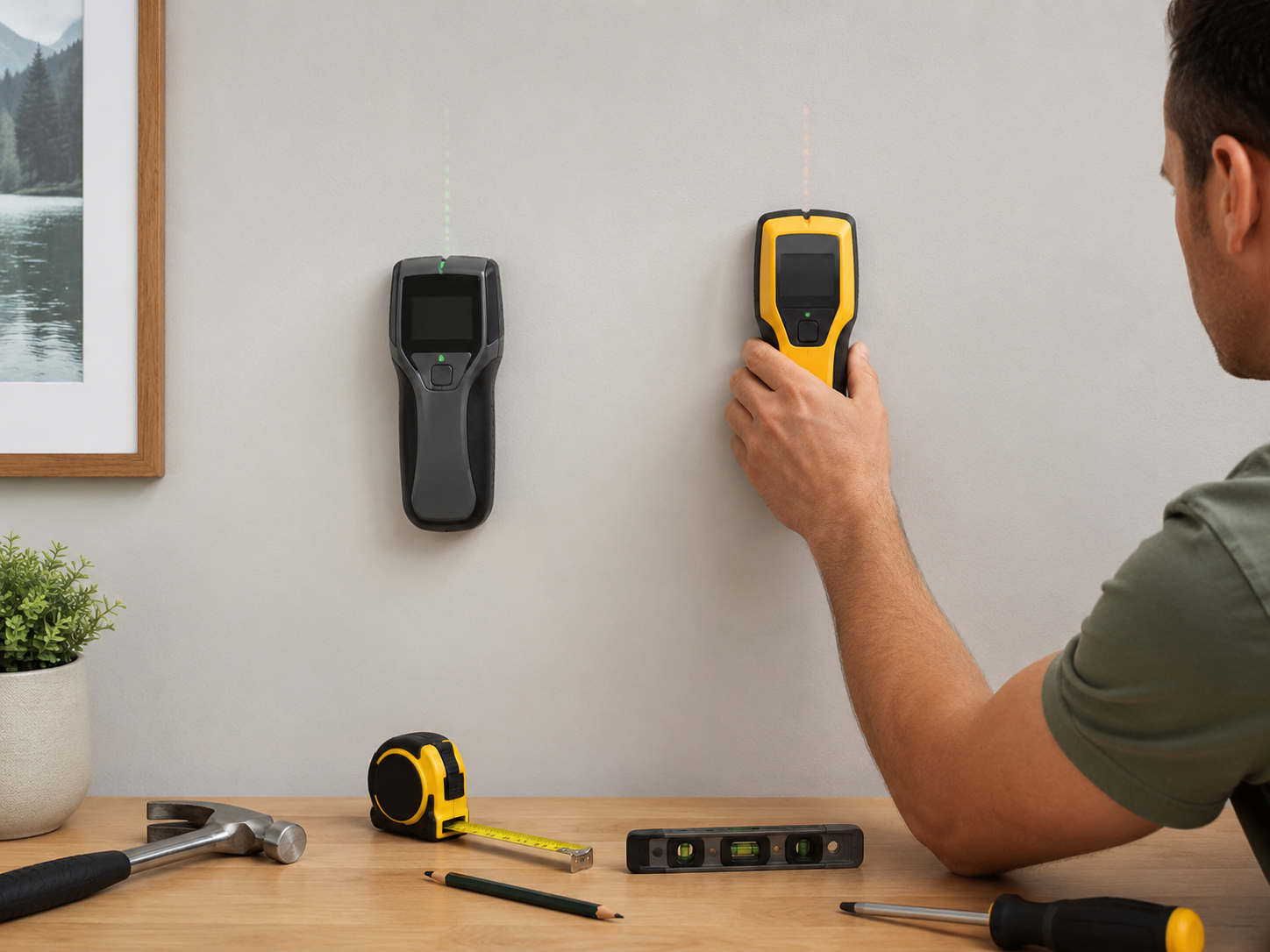
These two Franklin models are comparable because both focus on wood and metal stud location, no-calibration scanning, and showing the full width of a stud instead of only a single edge point. The M90 is the compact option. The 710 is the wider option with more sensors.
Franklin Sensors ProSensor M90
ASIN: B07DPT6HSY
Core angle: compact 9-sensor stud finder with 1.5-inch deep scan wording and no-calibration operation.
Franklin ProSensor 710
ASIN: B0064EICKG
Core angle: wider 13-sensor stud finder that shows centre and edges with a broad LED display.
Compact comparison table
| Feature | Franklin Sensors M90 | Franklin ProSensor 710 |
|---|---|---|
| Best fit | Compact household stud-finding tasks | Wider full-width stud display |
| Amazon.ca ASIN | B07DPT6HSY | B0064EICKG |
| Sensor count | 9 sensors listed | 13 patented sensors listed |
| Depth wording | 1.5-inch deep scan always on wording | Up to 1.6-inch deep scan wording |
| Stud display | LED display tracks centre and edges | Wide LED display shows centre and edges simultaneously |
| Calibration | No calibration required according to Franklin instructions | No calibration required according to Franklin product page and listing |
| Battery detail | Two AAA batteries listed on Amazon.ca and instruction references | Two non-rechargeable AA batteries listed on Amazon.ca |
| Important limitation | Detects density changes; does not identify exactly what hidden object is present | Detects density changes; does not replace safe drilling precautions |
| Amazon.ca | View M90 | View ProSensor 710 |
Where they differ
The biggest difference is the sensor layout. M90 uses a 9-sensor design. ProSensor 710 uses a 13-sensor design and a wider display. That does not automatically mean every homeowner needs the 710, but it does explain why the 710 feels like the broader scanning tool.
Sensor coverage
Franklin’s design idea is to show more than a single point. The M90 gives a smaller 9-sensor layout for simple jobs. The 710 expands that to a wider 13-sensor layout. If you mainly hang light shelves, curtain rods, or small fixtures, M90 may be enough. If you want the widest visual indication, the 710 has the stronger spec story.
The dots illustrate listed sensor count only. They do not represent guaranteed accuracy, safety, or wall-condition performance.
Battery and household convenience
M90 uses AAA batteries according to the Amazon.ca listing and instruction references. The 710 listing path specifies non-rechargeable AA batteries. That matters less than sensor layout, but it is still useful if you keep one battery type at home more often than the other.
Two AAA batteries listed
Two non-rechargeable AA batteries listed
Compact 9-sensor layout
Wider 13-sensor layout
Neither model replaces safe drilling checks
Franklin’s safety instructions warn that hidden wood, metal, wiring, pipes, or other objects may be present and may not always be identified as a specific object type. For any drilling or wall penetration, treat the stud finder as one step in the process, not the only safety check.
Why not compare by price?
Prices change too often to be useful inside a static guide. A better comparison is the part that does not change every day: sensor count, depth wording, battery type, display style, and which model fits your home projects.
Product breakdowns
Franklin Sensors ProSensor M90
The Franklin Sensors M90 is the compact pick in this comparison. The Amazon.ca listing identifies ASIN B07DPT6HSY and lists a 9-sensor wood and metal stud detector, full-width stud indication, 1.5-inch deep scan always-on wording, no calibration requirement, and two AAA batteries. Franklin’s M90 instruction sheet also explains that the device senses density changes and may indicate studs, beams, pipes, wires, or other hidden features rather than identifying the exact object type.
9 listed
1.5-inch deep scan
Two AAA listed
Simple home mounting tasks
For most small home projects, M90 is the easier recommendation. It keeps the Franklin full-width display concept but in a smaller format. It is a sensible fit for curtain rods, small shelves, picture rails, bathroom accessories, light utility hooks and general renter-friendly wall planning where you want to locate studs before deciding where hardware should go.
Main limitation: it is not a live-wire scanner and does not identify exactly what hidden object caused the reading. Use normal safety precautions before drilling or fastening into a wall.
See Which Version Fits Your SetupFranklin ProSensor 710
Franklin ProSensor 710 is the wider model. The Amazon.ca listing identifies ASIN B0064EICKG and lists 13 patented sensors, a wide LED display that shows the stud centre and edges simultaneously, deep scan always-on wording up to 1.6 inches, no calibration, and two non-rechargeable AA batteries. Franklin’s official ProSensor 710 page describes it as the original Franklin stud finder and points shoppers toward models such as the M210 when live-wire detection is needed.
13 listed
Up to 1.6 inches
Two AA listed
Wider wall scanning
Choose the 710 if you like the idea of the broad LED display and want more sensor coverage across the wall. This makes the most sense for repeated layout work, heavier mounting plans where you want more confidence about the stud width, or households that expect to use a stud finder more than once or twice.
Main limitation: it is still a stud finder, not a complete wall-safety scanner. If live-wire detection is central to the task, look at models built for that purpose and follow the manufacturer’s instructions carefully.
View Current Product OptionsDecision guide
Franklin Sensors M90
Pick M90 if you want a compact Franklin stud finder for typical home tasks and prefer the smaller 9-sensor format over the wider 710 body.
Franklin ProSensor 710
Pick ProSensor 710 if you want the wider 13-sensor display and expect to use the tool for repeated layout work or wider wall scanning.
Buying advice before you choose
Before choosing between Franklin Sensors M90 vs ProSensor 710 in Canada, match the tool to the job. A stud finder is useful for simple DIY projects, but it should not create false confidence before drilling into unknown walls.
- Choose by task frequency: M90 is enough for occasional household mounting; 710 is easier to justify if you use it repeatedly.
- Think about wall risk: near plumbing walls, switches, outlets and unknown renovations, use extra caution.
- Do not skip safety steps: turn off relevant power/water/gas where appropriate before drilling or penetrating a wall.
- Check battery type: M90 uses AAA batteries; the 710 listing specifies non-rechargeable AA batteries.
- Understand what it detects: these tools respond to density changes and may indicate hidden objects other than studs.
Fast setup filter
Occasional small projects: Franklin M90
Wider LED display: ProSensor 710
Live-wire priority: compare a model built for that feature
For more practical home-tool guides, browse Hamejur’s DIY & Home Tools and Simple DIY and Tools sections, or visit All Guides.
FAQ
Which stud finder has more sensors?
Franklin ProSensor 710 has more sensors on the listed specifications. The 710 listing describes 13 sensors, while the M90 listing describes 9 sensors.
Which one is better for occasional home projects?
For occasional home projects, the M90 is the easier starting point because it is the more compact 9-sensor option and still uses Franklin’s full-width stud display idea.
Does either model identify live electrical wires?
These two models should not be treated as live-wire scanners. Franklin’s own ProSensor 710 page points shoppers toward other models when live-wire detection is needed.
Can a stud finder guarantee it is safe to drill?
No. A stud finder can help locate density changes behind a wall, but it cannot guarantee that every pipe, wire or hidden object has been identified. Follow the manual and use appropriate safety steps before drilling.
Which model would I choose first?
I would choose M90 first for small household mounting tasks. I would choose the 710 if I wanted the wider 13-sensor display and expected to use the tool for more repeated layout work.
What I would choose
If I were buying one stud finder for simple apartment or home tasks, I would choose Franklin Sensors M90. It gives the Franklin full-width display approach in a compact 9-sensor format that is easier to justify for occasional shelves, curtain rods and small wall projects.
I would choose Franklin ProSensor 710 if I expected to use the tool often or wanted the wider 13-sensor LED display. The 710 is the better fit when the larger display itself is the feature you are paying for.
The practical answer is simple: choose M90 for compact occasional use, and choose ProSensor 710 for wider sensor coverage.
Sources and method
This guide compares listed manufacturer information, official instruction pages, Amazon.ca product identity pages and practical home-project fit. It does not include static prices, star ratings, review counts, stock claims or hands-on testing claims.
- Franklin Sensors M90 / M92 / M150 official instruction sheet
- Amazon.ca listing for Franklin Sensors ProSensor M90
- Franklin Sensors ProSensor 710 official product page
- Franklin Sensors T11 / T13 / 710 / 710+ official instruction sheet
- Amazon.ca listing for Franklin ProSensor 710
- How Hamejur compares products and Editorial Policy