Prices and availability can change. Use the Amazon.ca product page for the latest product details before ordering.
Home comfort
The Levoit 36-inch tower fan is the best balanced choice for most bedrooms and living spaces in this comparison because its current Amazon.ca listing combines 12 speeds, four modes, a 12-hour timer and 90-degree oscillation. Choose the Dreo when strong advertised airflow and a broader feature set matter and you are willing to confirm the exact current variant, or the Lasko 2511 when simple three-speed controls and a compact 12 × 12-inch base are the priority.
Contains paid affiliate links. Hamejur may earn a commission from qualifying purchases at no additional cost to you.
Placement, intake clearance and control range matter more in daily use than tower height alone. This contextual image does not show one of the exact models compared.
Side-by-side
Tower fan comparison
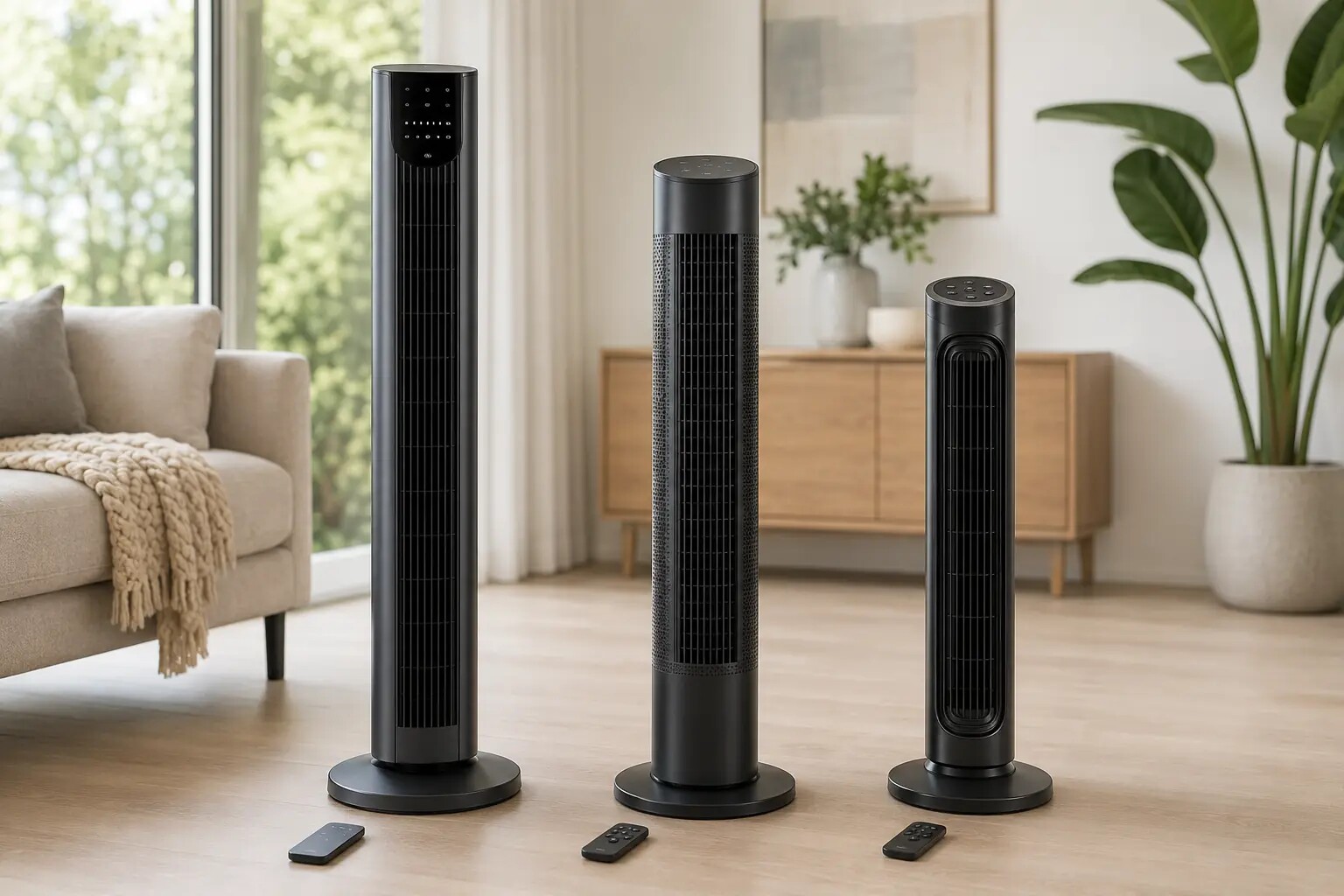
All three current Amazon.ca listings passed the product-set check and were in stock when refreshed. Their practical differences are control range, timer length, oscillation, footprint and how confidently the marketplace listing maps to current manufacturer documentation.
Marketplace titles can change. Exact ASIN identity, current availability and Amazon product images were refreshed through the Amazon.ca Creators API before this update.
What actually matters when choosing a tower fan
More speed levels help when the fan runs close to you
A large speed range is most useful in bedrooms, offices and small living spaces where the fan may sit a few feet from a chair or bed. Levoit’s current listing provides the widest adjustment range here at 12 speeds. Lasko’s three-speed layout is intentionally simpler and may be easier for guests or shared rooms.
Oscillation changes coverage more than tower height
Levoit and the current Dreo listing advertise 90-degree oscillation, while Lasko documents 60 degrees for the 2511. Wider oscillation can distribute air across a sofa or shared room, while a narrower sweep can be useful when you mainly want airflow directed through one part of a room.
Noise numbers need context
Levoit’s current 36-inch family documents operation as low as 25 dB, while Dreo’s current Amazon listing advertises a 20 dB minimum. Those numbers should not be treated as directly comparable laboratory results unless test conditions are the same. Lasko publishes low- and high-speed sound figures for the 2511 rather than one headline minimum.
Model identity matters when an ASIN changes over time
The Dreo ASIN in this comparison has carried model-family details that have not always agreed with current manufacturer pages. The current Amazon title advertises 28 ft/s airflow, eight speeds, four modes and 90-degree oscillation. Dreo’s current Canadian Tower Fan 518 page documents similar 28 ft/s airflow, 20 dB operation, four modes and 90-degree oscillation but lists nine speeds. That is why Dreo remains a qualified recommendation rather than the default pick.
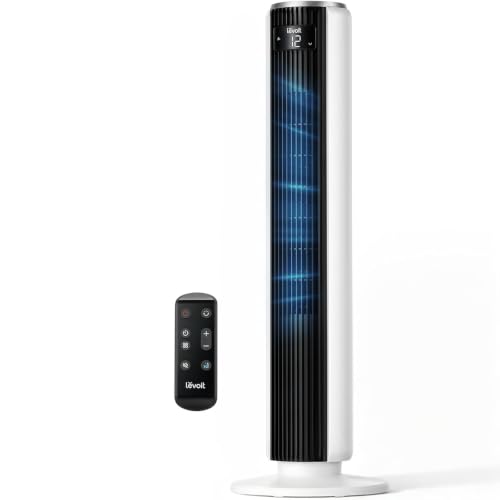
The current Amazon.ca listing describes a 36-inch tower fan with 12 speeds, four modes, a 12-hour timer, remote control, LED display, 90-degree oscillation and a 25 dB minimum-noise claim. Levoit’s current 36-inch tower-fan page independently documents 90-degree oscillation, quiet operation as low as 25 dB, remote control and a removable back cover for cleaning.
That combination makes Levoit the most balanced choice here. Fine speed adjustment helps when the fan runs near a bed or desk, and a removable rear cover is a practical maintenance advantage because tower-fan intakes collect dust over a season.
Why it stands out
12 speeds on the current Amazon.ca listing
90-degree oscillation and 12-hour timer
Current Levoit design includes a removable back cover
Consider first
Confirm the exact model identifier on the current listing
Many settings are unnecessary if you only use low, medium and high
Noise claims should not be compared across brands without matching test conditions
Dreo’s current Amazon.ca title advertises a DC-motor tower fan with airflow up to 28 ft/s, eight speeds, four modes, 90-degree oscillation and a 20 dB minimum-noise claim. Those are attractive numbers for a bedroom or larger living area, and the current listing was in stock during the API refresh.
The caution is model matching. Dreo’s current Canadian Tower Fan 518 page describes a very similar 28 ft/s, 20 dB, four-mode and 90-degree feature set but lists nine speeds rather than eight. Because the manufacturer page and marketplace ASIN do not map cleanly enough to treat every specification as identical, verify the model identifier and feature table shown on Amazon.ca before ordering.
Why it stands out
Strong 28 ft/s airflow claim in the current listing
Eight advertised speeds and four modes
90-degree oscillation for shared-room coverage
Consider first
Exact model-family details have changed on this ASIN
Manufacturer and marketplace speed counts are not fully aligned
Verify current listing details rather than relying on an older manual
Lasko’s official 2511 specifications are unusually clear: three speeds, a seven-hour auto-off timer, 60-degree oscillation, remote control, a 12 × 12-inch base, 36-inch height, 8.85 lb weight and 30 to 36 W energy output. It also uses Lasko’s Blue Plug fused safety technology.
This is the easiest model to recommend for straightforward use. It does not compete with Levoit on speed granularity, but it is simple to explain to guests, easy to place in a smaller room and backed by a current manufacturer page that maps cleanly to model 2511.
Why it stands out
Simple three-speed controls
Seven-hour timer and 60-degree oscillation
Compact 12 × 12-inch floor footprint
Consider first
Fewer speed levels than the other two
Less oscillation range than Levoit and Dreo
Choose it for simplicity rather than maximum settings
Use speed range, timer behaviour, oscillation and room placement to narrow the choice before comparing smaller specification differences.
Which tower fan should you buy?
Choose Levoit when…
Levoit fits best when its role matches your actual use case.
You want the widest fine-control range here, especially for a bedroom, office or shared living area where small speed changes and a long timer are useful.
Choose Dreo when…
DREO fits best when its role matches your actual use case.
You value the current listing’s strong airflow and broad controls and are comfortable confirming the exact current model before checkout.
Choose Lasko when…
Lasko fits best when its role matches your actual use case.
You prefer simple three-speed operation, a compact base and a model whose current official specifications are easy to verify.
Consider another cooling approach when…
You need the room temperature itself reduced. A fan improves air movement and perceived comfort but does not refrigerate or dehumidify a room.
What to check before buying a tower fan
Measure the base and intake clearance
Tower fans look narrow from the front, but the base and rear intake still need floor space. Keep the intake clear of curtains, bedding and furniture so airflow is not restricted.
Choose control complexity deliberately
Twelve speeds sound attractive, but many homes mainly use a few comfortable levels. Buy Levoit for fine adjustment, Dreo for its broader advertised feature set, or Lasko when simple controls are more useful than extra modes.
Use timers for convenience, not temperature control
Match the fan to the rest of the room-comfort setup
Dry winter bedrooms may benefit from a filter-free cool-mist humidifier, while allergy-focused rooms may need a compact smart air purifier. These devices solve different problems and should not be treated as interchangeable with a fan.
Frequently asked questions
Do tower fans cool a room like an air conditioner?
No. They circulate room air and can make you feel cooler, but they do not lower the room’s air temperature the way an air conditioner does.
Which model has the most speed settings?
The current Levoit listing has 12 speeds. The current Dreo listing advertises eight, while the Lasko 2511 has three.
Which is the simplest tower fan here?
The Lasko 2511. Its three-speed control system, seven-hour timer and remote are easier to understand than the broader mode sets on Levoit and Dreo.
Why does Hamejur warn about the Dreo model identity?
The current Amazon ASIN and current Dreo manufacturer-family pages do not align perfectly on every specification, including speed count. The exact current variant should therefore be confirmed before purchase.
Is a 20 dB fan automatically quieter than a 25 dB fan?
Not necessarily in a fair comparison. Noise numbers depend on test distance, speed setting and measurement method. Treat cross-brand minimum-noise claims as directional rather than directly interchangeable.
How should a tower fan be cleaned?
Unplug it first, remove dust from the intake and outlet, and follow the exact manufacturer instructions. Do not open or wash internal components unless the manual for that model permits it.
What I would choose
I would choose the Levoit 36-inch tower fan for most bedrooms and living rooms because its current 12-speed control range, 12-hour timer and 90-degree oscillation give it the most flexible everyday setup in this group.
I would choose the Lasko 2511 when simple operation matters more than extra settings. I would choose the Dreo only after confirming that the exact current variant matches the advertised specification set I expect.
Sources and method
This comparison uses current Amazon.ca Creators API data for exact ASIN identity, current availability, Amazon listing title, product image and affiliate URL. Manufacturer pages are used for technical and maintenance context. Hamejur does not claim hands-on testing of these tower fans.