Prices and availability can change. Use the Amazon.ca product page for the latest product details before ordering.
The Midea Cube is the strongest all-round 50-pint dehumidifier in this comparison for most Canadian basements and large rooms. Its unusually short body, large-tank design, Wi-Fi controls and flexible continuous-drain setup make it easier to fit into different spaces. The HOGARLABS 50-pint model is the simpler gravity-drain alternative, while the Amazon Basics 50-pint model is the one to choose when a built-in pump solves a difficult drainage route.
Current product check: this recovery version uses three Amazon.ca listings that passed Hamejur’s current product-set QA. The previous Frigidaire FFAD5034W1 and Danby DDR050BJP2WDB listings were removed from the active recommendations after the current Amazon.ca API reported both unavailable.
Contains paid affiliate links. Hamejur may earn a commission from qualifying purchases at no additional cost to you.
Quick verdict
Which 50-pint dehumidifier should you choose?
Best overall
Midea Cube 50 Pint
Midea fits best when its role matches your actual use case.
Choose Midea when compact height, a larger tank, app control and flexible continuous drainage matter more than having a built-in pump.
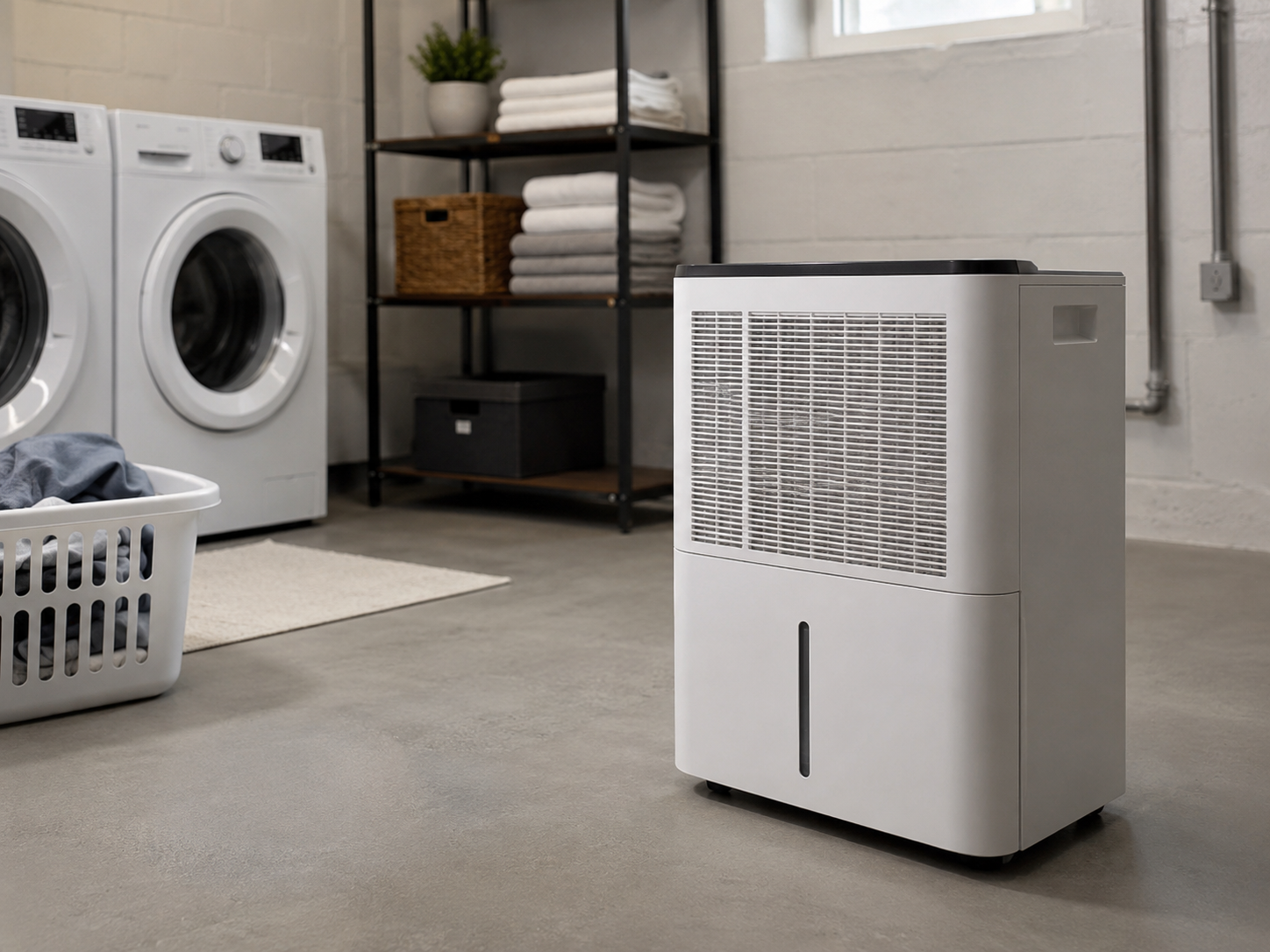
A dehumidifier’s drain route, clearance and filter access can matter as much as its headline pint rating. This is a contextual image rather than one of the exact models compared.
Side-by-side
Midea vs HOGARLABS vs Amazon Basics
All three current Amazon.ca listings are 50-pint models, but they solve different ownership problems. Midea emphasizes compactness and connected control, HOGARLABS emphasizes simple continuous drainage, and Amazon Basics adds a built-in pump.
Basements where water must move upward or to a difficult drain
Room-coverage figures are manufacturer or marketplace positioning, not guarantees for every basement. Temperature, starting humidity, air movement and room layout all affect moisture removal.
The differences that matter most
Drainage should usually decide the purchase first
A 50-pint unit can collect a surprising amount of water in a damp basement. If you have a floor drain below the appliance, gravity drainage may be enough. If the water has to rise to a sink, window or higher drain point, a built-in pump can remove the need to empty the bucket manually.
Midea is unusually short for this capacity class
Midea Canada lists the MAD50S1QWT-A at 14.76 × 14.45 × 14.57 inches and 42 lb. The Cube design can operate in an extended configuration and nest down for storage. That shorter shape can be useful under shelving or in a utility area where a conventional tall cabinet is awkward.
Midea is also the connected-control option
Midea documents Wi-Fi, smartphone-app support and Amazon Alexa and Google Assistant voice control. It also lists three fan speeds, automatic restart, frost protection, automatic shutoff, a washable filter and coverage up to 4,500 sq. ft. The important limitation is that the model does not include a built-in water pump.
HOGARLABS keeps the drainage system simple
HOGARLABS documents three modes: smart dehumidification, drying and continuous dehumidification. Its manufacturer page lists a 30%–80% humidity adjustment range, a 0.6-gallon tank, a drain hose for continuous drainage, automatic full-tank shutoff, a washable filter, wheels and pull handles. The brand also lists operation around 40 dB, though room acoustics and operating conditions can change perceived noise.
Amazon Basics is the pump-first option
The exact current Amazon.ca record returned by Hamejur’s connector identifies a 50-pint model with a built-in pump, continuous drainage, a 1.6-gallon water tank, Energy Star positioning, Auto and Turbo modes, auto-defrost, a timer and overflow protection. The same listing positions it for spaces up to 4,000 sq. ft. Those details are marketplace data for this exact ASIN, so check the live product page for any bundle or specification changes.
The Midea Cube is the most distinctive design here. Midea lists 50-pint capacity, coverage up to 4,500 sq. ft., three fan speeds, a removable bucket, washable filter, electronic controls, Wi-Fi readiness and app control. Its lift-and-twist body can operate extended or nest down to reduce storage height.
For continuous drainage, Midea documents no-bucket configurations over a sink or floor drain using the included drain hose. That is flexible when gravity is on your side, but there is no built-in pump. If your drain point sits above the unit, Amazon Basics is the more direct solution.
Why choose it
Short 14.57-inch listed height
Up to 4,500 sq. ft. manufacturer positioning
Wi-Fi, app and voice controls
Large-tank Cube design and continuous drain options
Consider first
No built-in pump
Connected features may be unnecessary for simple manual use
HOGARLABS is the simpler middle choice. The manufacturer lists three operating modes, a 30%–80% humidity adjustment range, automatic full-tank shutoff, a timer, panel lock, washable filter, wheels, handles and continuous drainage through the included hose.
The 0.6-gallon tank is the main trade-off. That smaller bucket makes continuous drainage more attractive in a genuinely damp space. This model makes the most sense where the unit can sit above a floor drain or another lower drainage point.
Why choose it
Three operating modes
Continuous gravity-drain hose included
30%–80% listed humidity range
Portable wheels and handles
Consider first
0.6-gallon listed tank
No built-in pump documented
Less extensive Canadian manufacturer documentation than Midea
The reason to choose this model is straightforward: the current Amazon.ca listing includes a built-in pump. That can matter in a basement where the practical drain point is a sink, window or higher outlet rather than a floor drain below the machine.
The current exact-ASIN listing also identifies a 1.6-gallon tank, Auto and Turbo modes, auto-defrost, a timer, overflow protection and Energy Star positioning. Unlike the Midea and HOGARLABS sections, these details are based on the current Amazon.ca product record rather than a separate manufacturer support page, so confirm them on the listing before ordering.
Why choose it
Built-in pump
1.6-gallon listed tank
Continuous drainage
Auto-defrost and timer listed
Consider first
Pump adds little value with an easy floor drain
Technical sourcing relies mainly on the exact marketplace listing
Check hose routing and pump lift requirements before placement
Decision guide
Choose Midea when…
You want a short, flexible body, a larger-tank design, connected controls and a gravity-drain route.
Choose HOGARLABS when…
You want straightforward humidity modes and continuous gravity drainage without paying for a pump-first design.
Choose Amazon Basics when…
The water needs to move upward or to a drain that gravity cannot reach conveniently.
Use the bucket only when…
The space is moderately damp or you can easily access the unit. For continuous basement duty, a drain hose often reduces maintenance significantly.
What to check before buying
Map the drain path before comparing features
Decide where the collected water will go. Measure whether the hose can slope continuously downward. If it cannot, a pump may matter more than Wi-Fi, extra fan speeds or a larger advertised coverage figure.
Leave room for airflow and filter access
Do not wedge a dehumidifier tightly between storage bins or against a wall. Follow the manufacturer’s clearance guidance and make sure you can remove and wash the filter without moving half the room.
Coverage figures are not sizing guarantees
A cold, divided or very wet basement can be harder to dry than an open room with the same floor area. Use square-foot claims as product positioning, then consider starting humidity, air circulation, temperature and how quickly moisture returns.
Plan for colder basement conditions
Dehumidifier performance can change at lower temperatures, and frost management matters. Midea documents frost protection and automatic defrost control; the Amazon Basics listing includes auto-defrost. For any model, check the operating-temperature range before using it in an unusually cold space.
Which 50-pint dehumidifier is best for a basement?
Midea is the strongest general-purpose choice here when you have a workable gravity drain and value compact height or app control. Amazon Basics is more suitable when a built-in pump solves the drainage problem.
Do I need a dehumidifier with a pump?
Not if water can flow continuously downhill to a nearby drain. A pump becomes useful when the drain point is higher than the appliance or otherwise difficult to reach by gravity.
Is a larger water tank always better?
A larger tank reduces emptying frequency when you use bucket collection. If you use continuous drainage, tank size becomes much less important.
Can a 50-pint dehumidifier cover an entire basement?
Possibly, but the answer depends on basement size, layout, humidity load, temperature and air movement. Treat manufacturer square-foot figures as guidance rather than a guarantee.
How often should the filter be cleaned?
Follow the exact model’s manual or manufacturer guidance. Washable filters still need inspection because dust buildup can restrict airflow and reduce performance.
Should a dehumidifier run continuously?
That depends on humidity conditions and the control mode. A humidistat-controlled or smart mode can cycle the compressor as needed, while continuous modes are more appropriate for specific high-moisture situations.
What I would choose
I would choose the Midea Cube for most basements because its compact form, large-tank design, app control and continuous-drain flexibility solve several everyday ownership problems at once.
I would choose the Amazon Basics pump model when drainage must move upward. The HOGARLABS 50-pint is the simpler alternative when a gravity drain is available and connected controls are not important.
Sources and method
Amazon identity, price, availability and product images come from the current Hamejur Amazon.ca Creators API connection. Manufacturer specifications are used where an official product page is available. Hamejur does not claim hands-on testing of these dehumidifiers.